Flasher performance
SEGGER Flashers are the fastest in-system programmers in the industry.
Maximum programming speed in practice

SEGGER Flashers are optimized for both flexibility and maximum programming speed across a wide range of target devices and interfaces. Their architecture combines highly efficient firmware, tightly integrated software components, and advanced programming algorithms to deliver consistently superior performance in real-world applications.
SEGGER guarantees that their Flashers are faster than any other in-system programmer on the market.
Flasher Top-Speed Guarantee
If a competing programmer outperforms Flasher in a identical real-world use case in terms of speed, SEGGER analyzes the scenario and identifies the limiting factors.
Targeted improvements are then implemented, such as firmware updates, algorithm refinements, or configuration adjustments, to close the performance gap.
If this cannot be achieved, a full refund can be granted within six months of purchase under the terms and conditions for the guarantee.
This approach reflects SEGGER’s commitment to measurable performance and continuous improvement. The goal is not only to keep pace with the fastest solutions available, but to define the benchmark for programming speed.
What makes SEGGER Flashers so fast?
Hardware architecture optimized for maximum speed
SEGGER Flasher hardware is purpose-built for high performance, combining specialized components with a flexible architecture to deliver leading programming speed:
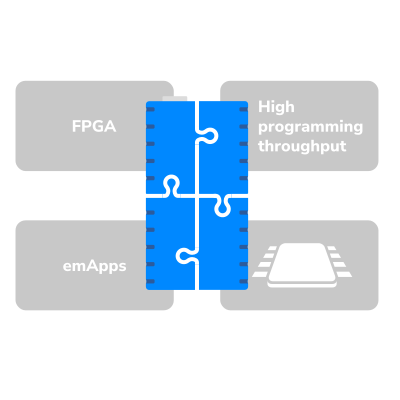
- High-speed SoC with integrated FPGA logic for accelerating critical operations
- Dedicated interface processors for fast, parallel communication with target devices
- Architecture optimized for high programming throughput
- Highly efficient virtual CPU based on emApps, enabling flexibility without compromising performance
Highly efficient firmware
SEGGER Flashers run firmware specifically designed for high-throughput programming.
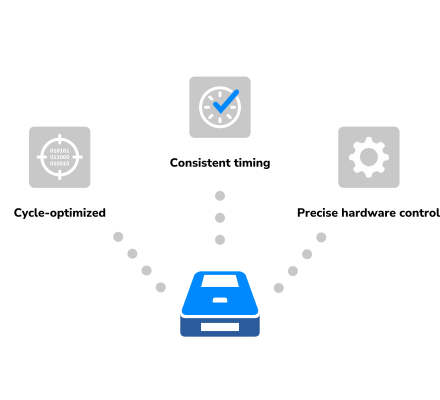
- Cycle-optimized code paths reduce instruction overhead
- Deterministic execution ensures consistent timing
- Low-level hardware control enables precise tuning for each target
- Minimal communication latency between host and programmer
Tightly integrated software components
SEGGER’s ecosystem is built from components designed to work together seamlessly.
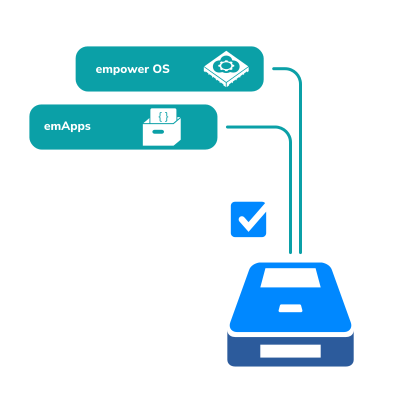
- emPower OS, including embOS for responsive real-time task scheduling, emNet for efficient, low-overhead communication, and many other proven components for embedded systems
- emApps and internal stacks are optimized for throughput
This integration:
- Avoids redundant buffering and copying
- Reduces context-switch overhead
- Enables parallel handling of communication and programming tasks
Turbo Mode
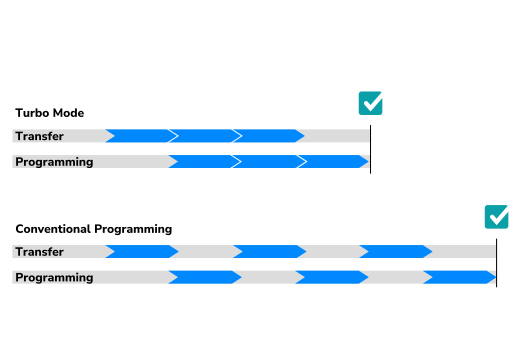
Turbo Mode maximizes programming throughput by overlapping data transfer and flash programming. It enables SEGGER Flashers to outperform conventional sequential programming approaches.
- Enables parallel data transfer and programming
- Eliminates interface idle time
- Ensures continuous target utilization
Optimized programming workflow
SEGGER Flashers optimize the entire programming cycle, not just data transfer.
Smart erase strategies
- Sector-based or selective erase instead of full chip erase
- Avoidance of unnecessary operations
Intelligent programming algorithms
- Skipping unchanged data where possible
- Target-specific flash loaders for maximum efficiency
Efficient verification
- Optimized routines such as block-based or CRC-assisted verification
- Balanced approach to speed and data integrity
Pipeline execution
- Overlapping operations, for example preparing the next block while programming the current one
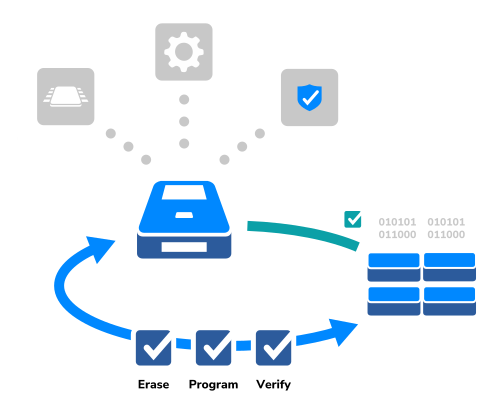
How programming speed is measured at SEGGER
Programming speed is not a theoretical value but a measurable result defined under controlled and reproducible conditions. At SEGGER, a consistent methodology is used to ensure that every measurement reflects real programming performance.
Speed is determined using a clearly defined setup:
Test setup
- Target device on a dedicated evaluation board
- Defined programmer (hardware model and configuration)
- Programming interface (e.g. JTAG, SWD, SPI)
- Fixed interface speed and protocol settings
- Execution mode (standalone or with host connection via USB or Ethernet)
Environmental conditions
- Stable and defined power supply
- Controlled physical setup, including cabling and signal integrity
Programming task
- Defined image size (full chip or specific memory region)
- Defined data pattern
- Selected memory type (internal flash or external memory)
This methodology ensures that all results are based on a known and repeatable scenario. It eliminates ambiguity and provides a reliable foundation for evaluating and improving programming performance.
Terms and conditions
SEGGER's Flasher Top-Speed Guarantee
To claim the guarantee, you must provide verifiable evidence that another programmer is faster in terms of programming speed according to the above-defined measuring procedure.
You must supply all relevant information for verification to SEGGER. SEGGER reserves the right to request access to, or provision of, the third-party programmer and evaluation board for testing and verification purposes.
Upon receipt of the required information, SEGGER will analyze and verify whether the third-party programmer outperforms the SEGGER Flasher under identical conditions. In such a case, SEGGER will use its best efforts to improve the Flasher to achieve faster or equal speed performance.
If SEGGER is unable to achieve faster or equal speed performance within a period of 6 weeks, you may return up to 10 Flashers and receive a refund, provided that such Flashers were purchased within the preceding 6 months and are free from any defects. This Top-Speed Guarantee applies only to Flashers purchased directly from SEGGER. Flashers purchased via distributors or resellers are excluded from this guarantee.