Authorized Flashing
Intellectual-property protection for product owners.
Overview
Authorized Flashing is a critical security feature for SEGGER Flasher in-system programmers, transforming them into secure firmware flash tools that help product owners protect what is theirs. Attacks on firmware images are increasingly of interest to hackers and other individuals who may seek unauthorized access for purposes of theft or counterfeiting.
Authorized Flashing employs a hidden partition (a secure area) that ensures that private information remains protected. Additionally, it enables users to determine the number of flash programming cycles in order to limit the number of devices that can be programmed.
Key features
IP protection
With Authorized Flashing, firmware images are hidden, making it difficult for an unauthorized party to access them by reading the firmware flash tool (the Flasher). As a result, images are secure and intellectual property (IP) remains protected throughout the flash programming process.
Configurable flash programming limits
During Flasher configuration, users can opt to limit flash programming cycles and, correspondingly, the number of devices that can be programmed. Once a pre-defined number of devices are programmed, the respective Flasher must be re-configured in order to start a new flash programming cycle.
Use cases

Service scenarios
In service scenarios (e.g., in the field), the firmware flash tool may get lost or left behind (accidentally forgotten at a service site, stolen, etc.). By limiting the number of flash programming actions that can be performed on a device, it reduces the potential damages incurred by unwanted third-party access.
Production scenarios
In production scenarios, not all manufacturing sites may be trusted sites. Authorized Flashing significantly increases security levels for flash programming in these environments. By enforcing strict limits, it ensures that neither overproduction nor IP theft can occur, effectively keeping your firmware secure regardless of where the firmware flash tool is located.
How Authorized Flashing works
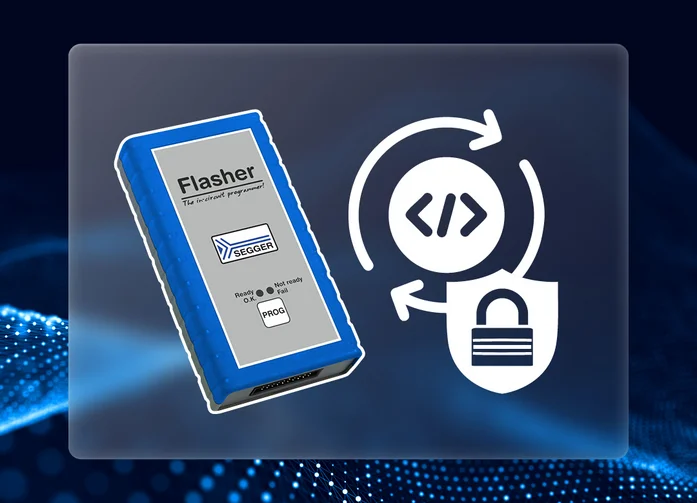
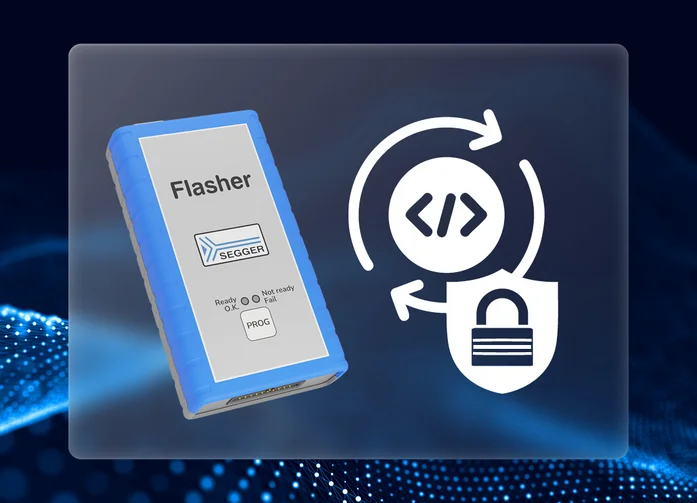
Flasher programmers allow creation of a hidden partition (secure area) that stores the data required for a programming process. This includes the firmware itself and the specific number of times it can be used for programming.
Half of a Flasher's storage is reserved for the secure area. This area can be removed at any time, which reallocates the full storage capacity to the public area.
Secure flash programming in action
Once a Flasher has been prepared, the hidden partition can no longer be accessed. At this point, the user is able only to start the flash programming process, using the hidden data. The secure area remains active until it is deliberately reset (erased) by the owner.
The workflow
The process is simple: A secure area is created as the Flasher is prepared for use; then, the Flasher is sent to the manufacturer (e.g., a contractor); and, finally, flash programming is triggered by the end user.
FAQ
What Flasher models support authorized flashing?
All Flasher models.
Does use of the Authorized Flashing mode limit available features (e.g., support for patch files)?
No. All features, such as support for multiple or patch files, etc., can also be used when operating from the secure area.
Do I need a license to use Authorized Flashing?
No. This feature is part of a Flasher device's default feature set.
Can Authorized Flashing prevent overproduction?
Yes. By requiring a signed license to enable flash programming, you effectively place a hard limit on production volume. If a contract manufacturer attempts to produce more units than authorized, the Flasher will simply refuse to operate once the licensed count is exhausted.
Does secure flash programming slow down production?
No. The authentication and counter updates happen instantly inside the Flasher. The speed of the flash programming itself remains optimized for the target memory, ensuring that adding security does not create a bottleneck on your assembly line.
Latest news
Get in touch with us
Have questions or need assistance? Our Embedded Experts are here to help!
Reach out to us for:
- Licensing quotes
- Technical inquiries
- Project support